

Power Requirements of Manual PE Pipe Welders | Complete Parameter Guide
Hey there! As a supplier of Manual PE Pipe Welders, I often get asked about the power requirements for these nifty machines. So, I thought I'd put together this blog post to clear up any confusion and give you all the deets.

★Understanding Manual PE Pipe Welders
First off, let's quickly go over what manual PE pipe welders are. They're tools used to join polyethylene (PE) pipes together. These pipes are super common in all sorts of applications, like water supply, gas distribution, and underground drainage. Manual welding means you have more hands - on control during the welding process, which can be great for smaller projects or when you need precise control.
★The Power Basics
When it comes to power, manual PE pipe welders typically rely on electricity. The main components that need power are the heating element and sometimes the motor for any moving parts.
★Heating Element Power
The heating element is the heart of the welding process. It heats up the ends of the PE pipes to a specific temperature so they can be fused together. The power required for the heating element depends on a few factors.
One of the key factors is the size of the pipes you're welding. Larger pipes need more heat to reach the right welding temperature. For example, if you're using a Manual Butt Fusion Welding Machine to weld small - diameter pipes (say, less than 50mm), the heating element might need around 1 - 2 kilowatts (kW) of power. But if you're dealing with larger pipes, like those over 200mm in diameter, you could be looking at a power requirement of 5 - 10 kW or even more.
Another factor that affects the heating element power is the type of PE material. Different grades of polyethylene have different melting points. Higher - density PE materials usually require more heat, and thus more power, to reach the welding temperature.
★Motor Power (If Applicable)
Some manual PE pipe welders have motors to help with functions like moving the clamping jaws or the heating plate. The power needed for these motors is generally much less compared to the heating element. Usually, it's in the range of a few hundred watts. For instance, a motor in a 200 Manual Pe Welding Machine might need around 300 - 500 watts to operate smoothly.

★Voltage And Current Requirements
In addition to power, you also need to consider voltage and current. Most manual PE pipe welders are designed to work with standard electrical supplies. In many countries, the common household voltage is around 110 - 120 volts or 220 - 240 volts.
The current draw of the welder depends on the power and the voltage. Using the formula (P = VI) (where (P) is power in watts, (V) is voltage in volts, and (I) is current in amperes), you can calculate the current. For example, if a welder has a power requirement of 2000 watts and is operating on a 220 - volt supply, the current draw would be (I=P/V=2000/220≈9.1) amperes.
It's important to make sure that your electrical supply can handle the current draw of the welder. If the current is too high for your circuit, it could cause the circuit breaker to trip or even damage the electrical system.
★Power Supply Considerations
When using a manual PE pipe welder, you need to pay attention to the quality of the power supply. A stable power supply is crucial for consistent welding results. Fluctuations in voltage can affect the temperature of the heating element, which in turn can lead to poor - quality welds.
If you're working in an area where the power supply is unstable, you might want to consider using a voltage stabilizer. This device can regulate the voltage and ensure that the welder gets a consistent power input.
★Comparing Different Models
Let's take a look at some specific models to see how their power requirements vary.
The 160 Manual Butt Fusion Machine is designed for welding pipes up to 160mm in diameter. This machine usually has a heating element power requirement of around 3 - 5 kW, depending on the exact model and the manufacturer. The motor, if it has one, might draw around 200 - 300 watts.
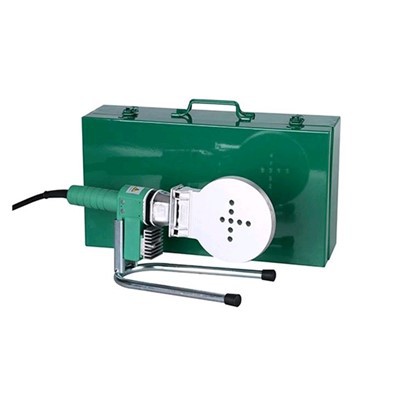
On the other hand, some smaller manual welders, like those used with socket joints with a Socket Jig, might have much lower power requirements. These could be in the range of 500 - 1000 watts for the heating element and maybe 100 watts for any motor - driven parts.

★Manuals And Guides
If you're unsure about the power requirements of a particular manual PE pipe welder, the best place to look is the machine's manual. For example, the 160mm Butt Fusion Machine Manual will provide detailed information about its power consumption, voltage requirements, and any other electrical specifications.
★Conclusion
In conclusion, the power requirements for a manual PE pipe welder depend on several factors, including the size of the pipes, the type of PE material, and the specific functions of the machine. It's important to understand these requirements to ensure that you have a suitable power supply and can achieve high - quality